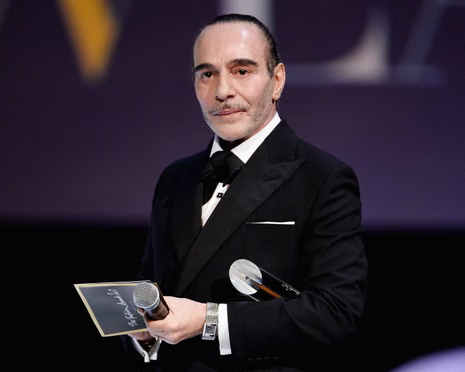

John Galliano is one of the most influential and controversial designers in modern fashion. Known for theatrical collections, historical references, dramatic silhouettes, and exceptional craftsmanship, he built a remarkable career that took him from London’s Central Saint Martins to some of the world’s most prestigious fashion houses. His story, however, is about much more than creative success. It also includes a devastating professional collapse, public condemnation, rehabilitation, and a remarkable return to the fashion world.
Galliano’s career has raised difficult questions about artistic talent, personal responsibility, forgiveness, and whether creative achievements can be separated from serious personal wrongdoing. His years at Maison Margiela demonstrated his ability to reinvent himself creatively, while his departure from the house created fresh questions about what the next chapter of his career might look like.
Early Life and Fashion Education
John Galliano was born Juan Carlos Antonio Galliano-Guillén in Gibraltar on November 28, 1960. His family later moved to South London, where he grew up in an environment that would eventually influence his dramatic approach to fashion.
He studied fashion design at Central Saint Martins in London. His graduate collection, inspired by the French Revolution, immediately attracted attention and revealed many of the qualities that would define his career. Historical research, theatrical presentation, storytelling, and imaginative construction were already central to his creative identity.
Rather than viewing clothing simply as something practical to wear, Galliano treated fashion as a form of performance. His early work established a distinctive visual language and helped him gain recognition within London’s influential fashion community.
The Rise of a Revolutionary Designer
During the late 1980s and early 1990s, Galliano developed a reputation for romantic, dramatic, and highly theatrical designs. His collections often drew inspiration from historical periods, cultures, and fictional characters. However, he rarely reproduced those references literally. Instead, he transformed them into exaggerated and imaginative fashion narratives.
His talent eventually attracted major international attention. In 1995, Galliano became creative director of Givenchy, making him the first British designer to lead the prestigious French couture house. The following year, he moved to Christian Dior.
His arrival at Dior became one of the defining moments of his professional life. Galliano brought fantasy, drama, and spectacle to the historic brand while maintaining a connection with the house’s established traditions.
The Dior Years
At Dior, Galliano became famous for collections that combined couture craftsmanship with dramatic storytelling. His runway presentations became major fashion events that attracted editors, celebrities, photographers, and fashion enthusiasts from around the world.
His designs frequently featured elaborate construction, exaggerated proportions, intricate embroidery, and references to different periods of history. He also became closely associated with unforgettable celebrity and red-carpet fashion, helping strengthen the relationship between luxury fashion and popular culture.
The success of his Dior years established Galliano as one of the most recognizable designers of his generation. His creativity was celebrated internationally, but the intense pressure surrounding his position also coincided with personal struggles that would eventually have serious consequences.
The 2011 Scandal
The darkest chapter of Galliano’s career came in 2011. Videos emerged showing him making antisemitic and racist remarks in Paris while apparently intoxicated. The footage caused international outrage and resulted in his dismissal from Dior.
A French court later convicted him over antisemitic behavior connected with incidents in Paris and imposed a suspended fine.
The professional consequences were immediate. His reputation suffered enormously, and his own fashion label was also affected. For a designer who had spent decades establishing himself as one of fashion’s most celebrated creative figures, the fall was extraordinary.
The remarks were deeply offensive and cannot be dismissed as simply another example of eccentric celebrity behavior. Galliano has subsequently acknowledged the seriousness of what he did and has spoken about the shame and responsibility associated with his actions.
A Difficult Road Back
After the scandal, Galliano entered treatment and began confronting his problems with alcohol and addiction. His return to the fashion industry did not happen immediately. For several years, his professional future remained uncertain.
His personal journey later became the subject of the documentary High & Low: John Galliano, directed by Kevin Macdonald. The film explored his extraordinary rise, addiction, public downfall, and efforts to rebuild his life.
Galliano’s eventual return to major fashion came through Maison Margiela. In 2014, he was appointed creative director of the Paris-based fashion house. The appointment represented an important professional second chance, but it also placed him in an environment where he had to demonstrate that his creativity could evolve.
Transforming Maison Margiela
Galliano’s work at Maison Margiela became one of the most interesting chapters of his career. Instead of simply recreating the theatrical style associated with Dior, he engaged with the experimental philosophy and unconventional traditions of the Margiela house.
Over approximately a decade, he developed new approaches to construction, deconstruction, repurposing, and couture craftsmanship. His work explored how garments could be taken apart, reconstructed, transformed, and given new meaning.
The Artisanal collections became particularly important to his reputation. These presentations demonstrated extraordinary technical ability while combining unusual materials, historical references, and unconventional silhouettes.
His Maison Margiela period showed that Galliano was capable of evolving rather than simply returning to the style that had made him famous. It became an important part of his creative legacy.
Why His 2024 Departure Mattered
In December 2024, Galliano announced that he was leaving Maison Margiela after around ten years at the fashion house. His January 2024 Artisanal collection had already been widely regarded as one of the strongest presentations of his later career.
The departure was significant because Galliano left after producing work that had restored much of the industry’s respect for his creative abilities. Rather than immediately announcing another major position, he kept his future plans private.
In early 2025, Glenn Martens was appointed artistic director of Maison Margiela, succeeding Galliano and beginning a new chapter for the house.
Galliano’s departure therefore marked the end of a remarkable period in which he successfully reinvented his creative identity while working within one of fashion’s most unconventional brands.
John Galliano and His Complicated Legacy
The legacy of John Galliano is impossible to describe in simple terms. On one side is an extraordinary body of work that influenced couture, runway presentation, celebrity fashion, and fashion storytelling. On the other side is the serious harm caused by his antisemitic and racist remarks.
A fair assessment has to acknowledge both realities.
His creative achievements explain why fashion historians, designers, museums, and students continue to study his collections. His misconduct explains why discussions about his career remain controversial.
His later return to fashion also demonstrates that professional rehabilitation does not automatically erase the consequences of past actions. A person can acknowledge wrongdoing and work toward change while the public continues to debate whether and how that person should be celebrated.
The 2026 Met Exhibition Controversy
Galliano’s complicated legacy became especially relevant in 2026 when plans were announced for a 2027 Costume Institute exhibition at the Metropolitan Museum of Art dedicated to his career.
The proposed exhibition was expected to examine several decades of his work and creative development. However, the announcement generated significant criticism because of his history of antisemitic and racist remarks.
The controversy eventually contributed to the cancellation of the planned exhibition in August 2026. Galliano and the museum agreed to abandon the project rather than allow the dispute surrounding his past to overshadow the institution’s wider cultural work.
The decision demonstrated that, despite the passage of more than a decade since the 2011 scandal, Galliano’s past remains an important part of how his public legacy is viewed.
What Makes His Design Approach Influential?
Galliano’s influence comes largely from his ability to combine craftsmanship with storytelling. His clothes often appear to belong to a character, historical period, fantasy world, or carefully constructed narrative.
He also understood the importance of presentation. His runway shows were not simply displays of garments. They were carefully developed experiences involving music, styling, models, staging, atmosphere, and storytelling.
At Maison Margiela, his approach became more experimental. He explored construction, deconstruction, transformation, and traditional couture techniques while respecting the house’s distinctive identity.
This mixture of imagination and technical skill explains why his work continues to attract attention from fashion professionals and students.
FAQ About John Galliano
Who is John Galliano?
John Galliano is a British fashion designer best known for his work at Givenchy, Christian Dior, and Maison Margiela. He became internationally recognized for theatrical couture, historical references, dramatic runway presentations, and elaborate craftsmanship.
Why did John Galliano leave Dior?
He was dismissed from Dior in 2011 after videos emerged showing him making antisemitic and racist remarks. A French court later convicted him over antisemitic behavior connected with incidents in Paris.
When did John Galliano join Maison Margiela?
Galliano became creative director of Maison Margiela in 2014. His appointment marked his return to a major leadership position within the international fashion industry after his professional downfall.
When did he leave Maison Margiela?
Galliano announced his departure from Maison Margiela in December 2024 after approximately ten years with the house.
What happened to the planned 2027 Met exhibition?
The proposed exhibition dedicated to Galliano’s career was canceled in August 2026 following criticism surrounding his past antisemitic and racist remarks.
Conclusion
John Galliano remains one of fashion’s most complicated and fascinating figures. His journey from Central Saint Martins to Givenchy and Dior, followed by his devastating 2011 downfall and remarkable Maison Margiela comeback, represents both extraordinary artistic ambition and the serious consequences of personal actions.
His story demonstrates why a person’s legacy is rarely straightforward. Galliano created work that changed the language of modern fashion, but his past cannot responsibly be ignored when discussing his career.
His decade at Maison Margiela proved that his creative abilities remained powerful and that he could evolve as a designer. At the same time, the controversy surrounding his legacy shows that artistic achievement does not erase accountability.
Ultimately, John Galliano will continue to occupy a complicated place in fashion history. His designs remain influential, his craftsmanship remains highly respected, and his career continues to generate debate about creativity, responsibility, redemption, and the lasting consequences of public actions.