
Introduction
Miguel Ángel Félix Gallardo was one of the most influential and controversial figures in the history of Mexican organized crime. Known as the “Jefe de Jefes,” meaning “Boss of Bosses,” he became famous for establishing the Guadalajara Cartel and developing powerful drug-trafficking networks between Mexico and the United States. His influence during the 1970s and 1980s helped shape the criminal landscape that continues to affect Mexico.
The story of Miguel Ángel Félix Gallardo is not simply about wealth, power, and criminal connections. It is also a story involving corruption, violence, law enforcement investigations, and the devastating consequences of the international drug trade. After spending decades in prison, he died on November 15, 2026, at the age of 80, marking the end of a life that had attracted international attention for decades.
Early Life and Background
Miguel Ángel Félix Gallardo was born on January 8, 1946, in Culiacán, Sinaloa, Mexico. He grew up in a region that later became closely associated with Mexico’s organized drug trade. Although relatively little reliable information is publicly available about his childhood and private family life, his early professional background provides important context for understanding his rise.
Before becoming involved in organized crime, Félix Gallardo reportedly worked in law enforcement. His experience as a police officer helped him understand the structures of government institutions and the importance of political relationships.
He also reportedly worked as a bodyguard for Leopoldo Sánchez Celis, a former governor of Sinaloa. These connections gave him access to influential circles and helped him develop relationships that would later become important to his criminal operations.
Rise to Power
During the 1970s, Félix Gallardo gradually became involved in drug trafficking. What distinguished him from many other criminal figures was his ability to build relationships, organize operations, and establish connections across different regions.
Rather than relying entirely on individual criminal activities, he helped develop a coordinated network that connected producers, transporters, distributors, and corrupt officials.
His growing influence eventually made him one of the leading figures in Mexico’s drug trade. He became associated with several important traffickers, including Rafael Caro Quintero and Ernesto Fonseca Carrillo, also known as Don Neto.
Together, these figures became closely connected with the Guadalajara Cartel, an organization that played a major role in the development of modern Mexican drug trafficking.
The Guadalajara Cartel
The Guadalajara Cartel became one of Mexico’s most powerful criminal organizations during the 1980s. Under the leadership of Félix Gallardo and other influential figures, it developed extensive trafficking networks and established connections with international drug suppliers.
The organization transported marijuana and other illegal drugs while expanding its cocaine distribution operations through relationships with Colombian traffickers.
Its connections with Colombian criminal organizations, including networks associated with Pablo Escobar, helped strengthen the movement of cocaine through Mexico toward the United States.
Félix Gallardo became known for coordinating different criminal groups rather than personally controlling every operation. This organizational approach allowed the cartel to expand its influence and maintain relationships across several regions.
However, its growing power also contributed to corruption, intimidation, and serious violence.
Relationship With Pablo Escobar
One important part of the Guadalajara Cartel’s history was its relationship with Colombian cocaine suppliers.
During the 1980s, Mexican trafficking organizations became increasingly important to the transportation of cocaine into the United States. Colombian suppliers needed reliable routes through Mexico, while Mexican traffickers benefited from access to a valuable international market.
Félix Gallardo’s organization developed connections with Colombian trafficking networks associated with Pablo Escobar and the Medellín Cartel.
These relationships helped transform Mexico into an increasingly important transit country in the international cocaine trade.
Although popular entertainment sometimes portrays these relationships as personal friendships or direct business partnerships, the historical reality involved complex criminal networks and changing alliances.
The Murder of Enrique Camarena
One of the most significant events associated with Félix Gallardo’s criminal history was the 1985 kidnapping and murder of Enrique “Kiki” Camarena, an American Drug Enforcement Administration agent.
Camarena had been investigating drug-trafficking operations connected to the Guadalajara Cartel. His work exposed important information about the organization’s activities and attracted considerable attention from Mexican and American authorities.
In February 1985, Camarena was kidnapped in Guadalajara. Mexican pilot Alfredo Zavala Avelar was also abducted. Both men were subsequently murdered.
Their deaths created an international controversy and intensified pressure on Mexican authorities to investigate the people connected to the crime.
The investigation became a major turning point in relations between American and Mexican law enforcement agencies. It also contributed to the eventual downfall of several prominent Guadalajara Cartel figures.
Félix Gallardo was later convicted in connection with the kidnapping and murder. He denied responsibility, but the conviction resulted in another lengthy prison sentence.
Arrest and Imprisonment
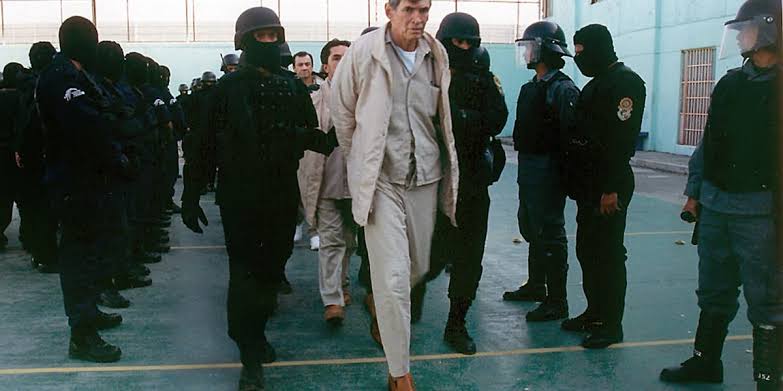
In April 1989, Mexican authorities arrested Miguel Ángel Félix Gallardo. His capture represented a major moment in the country’s fight against organized drug trafficking.
He was initially sentenced to 40 years in prison for drug-related offenses, weapons offenses, and bribery-related crimes.
In 2017, he received an additional 37-year sentence for his involvement in the kidnapping and murder of Enrique Camarena and Alfredo Zavala.
His combined sentences amounted to 77 years, although reports sometimes describe the total differently depending on the legal calculations being discussed.
After his arrest, the Guadalajara Cartel gradually lost its centralized structure. Its criminal networks became divided among different regional organizations, contributing to the development of several powerful trafficking groups.
Health Problems and Final Years
Félix Gallardo spent more than three decades behind bars. As he grew older, his health reportedly deteriorated significantly.
News reports described several medical problems, including diabetes, hypertension, hearing difficulties, and serious vision problems. He also experienced mobility limitations that made everyday activities increasingly difficult.
His legal representatives repeatedly requested that he be allowed to serve his sentence under house arrest because of his age and medical condition.
In 2022, a judge approved a measure that could have allowed house arrest under certain conditions. However, legal challenges prevented the transfer from being completed.
During his final years, Félix Gallardo remained in the Puente Grande prison complex in Jalisco, where he continued serving his sentences.
Death at Age 80
Miguel Ángel Félix Gallardo died on November 15, 2026, in a private hospital in Guadalajara, Jalisco, Mexico. He was 80 years old.
According to reports, he had been transferred from Puente Grande prison to the hospital on November 13 after experiencing serious health complications. Despite receiving medical attention, his condition continued to deteriorate.
Authorities reported that multiple organ failure was the cause of his death. His passing ended a period of more than 37 years in state custody following his arrest in 1989.
His death attracted international attention because of his historical importance in the development of Mexico’s organized drug trade and his connection to the murder of DEA agent Enrique Camarena.
Although his final years were largely defined by imprisonment and medical difficulties, his criminal legacy remained a subject of public discussion.
Influence on Modern Mexican Cartels
The Guadalajara Cartel’s decline did not bring an end to organized drug trafficking in Mexico. Instead, its former networks and territories became divided among different criminal organizations.
Several former associates and members later became connected with powerful trafficking groups, including organizations associated with the Sinaloa and Tijuana cartels.
Joaquín “El Chapo” Guzmán, who had previously worked within the Guadalajara Cartel’s network, eventually became a major figure in the Sinaloa Cartel.
This transformation illustrates how the collapse of one organization can create opportunities for new groups to expand.
Félix Gallardo’s influence is therefore often discussed in connection with the broader history of Mexican organized crime. His organizational approach helped establish patterns of trafficking and regional alliances that shaped later criminal operations.
However, it would be inaccurate to attribute every development in Mexico’s modern drug trade to one individual. Political corruption, international demand, economic conditions, and competition between criminal groups all played important roles.
Portrayal in Popular Culture
The life of Miguel Ángel Félix Gallardo also reached a much wider audience through television and documentaries.
Netflix’s crime drama Narcos: Mexico introduced his story to international viewers. Actor Diego Luna portrayed Félix Gallardo, presenting a dramatized version of his rise, relationships, and involvement in the Guadalajara Cartel.
The series explores the connections between drug traffickers, government officials, law enforcement agencies, and international criminal networks.
Although the production is based on historical events, it includes dramatic storytelling and fictionalized elements. Viewers should distinguish its entertainment narrative from documented historical and legal records.
Nevertheless, the series renewed interest in the history of Mexican drug trafficking and introduced a new generation of viewers to the events surrounding Félix Gallardo.
Legacy and Historical Significance
The legacy of Miguel Ángel Félix Gallardo remains deeply controversial. Some historical accounts describe him as an important organizer who helped transform Mexico’s drug-trafficking industry into a more coordinated international business.
However, this organizational influence came with serious human consequences. Drug trafficking, corruption, intimidation, and violence affected communities on both sides of the Mexican-American border.
The murder of Enrique Camarena became one of the most recognizable cases associated with the Guadalajara Cartel and remains an important chapter in the history of international drug enforcement.
His death in 2026 does not erase the consequences of the criminal networks associated with his era. Instead, it provides an opportunity to examine how organized crime developed and why its influence has been so difficult to eliminate.
Understanding his history requires looking beyond the nickname of the Boss of Bosses and recognizing the wider political, economic, and social circumstances that allowed criminal organizations to become so powerful.
Frequently Asked Questions
Who was Miguel Ángel Félix Gallardo?
Miguel Ángel Félix Gallardo was a Mexican drug trafficker and one of the founders and leading figures of the Guadalajara Cartel. He became known internationally for his influence over drug-trafficking networks during the 1970s and 1980s.
When did Miguel Ángel Félix Gallardo die?
He died on November 15, 2026, at the age of 80 in a private hospital in Guadalajara, Mexico. Authorities reported multiple organ failure as the cause of death.
Why was he called the Boss of Bosses?
He received the nickname “Jefe de Jefes” because of his influence over several trafficking networks and his position among Mexico’s most powerful organized-crime figures.
Was Miguel Ángel Félix Gallardo connected to Pablo Escobar?
His organization developed relationships with Colombian cocaine-trafficking networks associated with Pablo Escobar and the Medellín Cartel. These connections helped strengthen cocaine transportation routes through Mexico.
Why was he arrested?
He was arrested in April 1989 and later convicted of drug-related offenses and other crimes. He also received a 37-year sentence in 2017 for the kidnapping and murder of DEA agent Enrique Camarena and Mexican pilot Alfredo Zavala.
How many years was his prison sentence?
He received a 40-year sentence for earlier offenses and an additional 37 years in connection with the Camarena and Zavala murders, bringing the combined sentences to 77 years.
Conclusion
The life of Miguel Ángel Félix Gallardo represents an important and troubling chapter in the history of organized crime in Mexico. From his early connections in Sinaloa to his leadership role in the Guadalajara Cartel, he helped establish criminal networks that influenced the international drug trade for decades.
His arrest in 1989, subsequent convictions, and decades in prison marked the end of his personal control over those operations, but the criminal networks associated with his era continued to evolve.
His death on November 15, 2026, brought his personal story to a close. However, the historical questions surrounding his influence, the Guadalajara Cartel, and the consequences of organized drug trafficking remain relevant. His story serves as a reminder that the growth of criminal empires can leave lasting effects on governments, communities, and generations long after their leaders are gone.