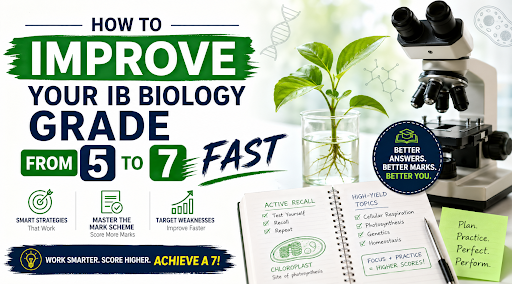

If you’re trying to understand how to get a 7 in IB Biology, the answer lies in fixing these gaps. This guide breaks down what actually works.
Understand why you’re stuck at a 5–6 level
Most students stuck at 5 or 6 know facts but struggle to connect or apply them. The real issue is passive revision rereading notes creates a shallow understanding. Examiners separate recognition from actual use, and without active recall, the 7 stays out of reach.
Learn to think like the IB mark scheme
Mark schemes reward specific language and structure. Writing a correct but loosely worded answer often earns partial credit at best. Three shifts in how you write answers make the difference.
Using key terms exactly as examiners expect
Each IB Biology topic has a set of non‑negotiable terms. For photosynthesis, you must write light‑dependent reactions and the Calvin cycle instead of vague phrases like “the first part” and “the second part”. Examiners scan for these exact phrases.
Avoiding unnecessary or irrelevant detail
Extra information does not help. Writing everything you know about a topic wastes time and can bury the correct answer. If a question asks for one function of the liver, give one. Adding four more functions will not earn extra marks.
Practising “point‑based” answer writing
Mark schemes award points for individual statements rather than whole paragraphs. Each correct statement earns a mark. Breaking answers into single-sentence points improves clarity. A quick check against the mark scheme involves three steps:
- Compare your wording to the official point
- Spot where your version matches or differs
- Redo any statement that falls short
Master high-yield IB Biology topics
Some topics appear far more often on IB Biology exams cellular respiration, photosynthesis, genetics, and homeostasis come up nearly every session. A quick review of past papers shows which areas deserve study time first. Prioritising high‑frequency topics lifts your grade faster than covering everything evenly.
Practice active recall and past papers daily
Active recall means pulling information from memory without looking at notes. Writing down everything you remember about a topic, then checking what you missed, builds stronger retention than rereading.
Do this daily and combine it with IB Biology past papers practice. The timed sessions reveal where you hesitate and build exam stamina. A simple weekly routine includes three steps:
- Write answers to a full past paper under timed conditions.
- Check every mistake against the mark scheme.
- Repeat the same questions until the answers come easily.
Improve your command of IB Biology terminology
Biology has its own language. Using it poorly costs marks even when you understand the concept. A few specific shifts in how you use terminology will raise your score fast.
Using precise scientific language
A student who writes “the thing that makes energy” instead of “mitochondrion” or “ATP” loses credit. The same happens with “the plant’s food factory” instead of chloroplast or glucose. Examiners expect precise scientific language, so replacing vague phrases with correct terms directly lifts your mark.
Avoiding vague explanations
“Blood pressure increases because the heart works harder” is too vague. A precise answer says the sympathetic nervous system releases noradrenaline, which increases heart rate and stroke volume, raising cardiac output and blood pressure. Examiners do not reward vague statements.
Building a strong biology vocabulary bank
A separate notebook for terminology works well. Adding each new term with a short definition and one example sentence builds a useful reference. Reviewing this bank for five minutes each morning helps the right words come to mind without effort within weeks.
Fix common exam mistakes that lose easy marks
Small errors drop grades quickly, but most students keep making the same ones without realising. The next sections cover three specific mistakes that cost easy marks more often than any others.
Not answering the command term properly
Each command term in IB exams asks for a specific depth of response. Confusing outline with explain, or state with describe, leads to answers that miss what examiners want. A student who outlines when the question asks for an explanation throws away marks for no reason.
Missing keywords in mark schemes
Examiners build mark schemes around a small set of high‑value keywords. Leaving out just one of those terms loses an easy point. After each past paper, line up your responses against the official mark scheme answers in IB Biology. Missed keywords stand out, and a quick review fixes them for next time.
Poor time management during exams
Time management during IB exams often separates a 5 from a 7. Spending 20 minutes on a 6‑mark task leaves too little time for a 10‑mark one later. Allocating minutes per mark across every paper fixes this problem. A 4‑mark item deserves about 7 minutes, while a 9‑mark one needs roughly 16.
Use a structured study strategy for fast improvement
Studying without a plan wastes time. A clear structure accelerates progress. The following three habits turn scattered revision into a reliable system.
Daily practice schedule for biology
A strong study session breaks down into three parts. First, 20 minutes of active recall on yesterday’s topic. Then, 30 minutes of past paper questions on today’s topic. Finally, 10 minutes reviewing mistakes from both.
Combining notes, questions, and revision
Learning and testing work better together than apart. A solid method starts with closing the notes right after reading. Then comes answering questions, checking the answers, and revising only the errors. This cycle moves faster than any other approach.
Tracking weak topics and improving them
A simple log helps track weak spots. Recording the topic each time marks drop creates a clear pattern. After three past papers, it becomes obvious which areas need extra work.
When progress stalls despite consistent practice, working with an IB Biology tutor can help identify gaps faster and correct them with targeted feedback.
The bottom line on breaking past a 5
Raising your grade from a 5 to a 7 has little to do with working twice as hard. The right IB Biology study tips focus on three things: how you revise, what you prioritise, and how well you understand the mark scheme. Each one helps on its own. Together, they change your score completely. Strong IB Biology exam technique turns these three shifts into higher results without doubling study hours.