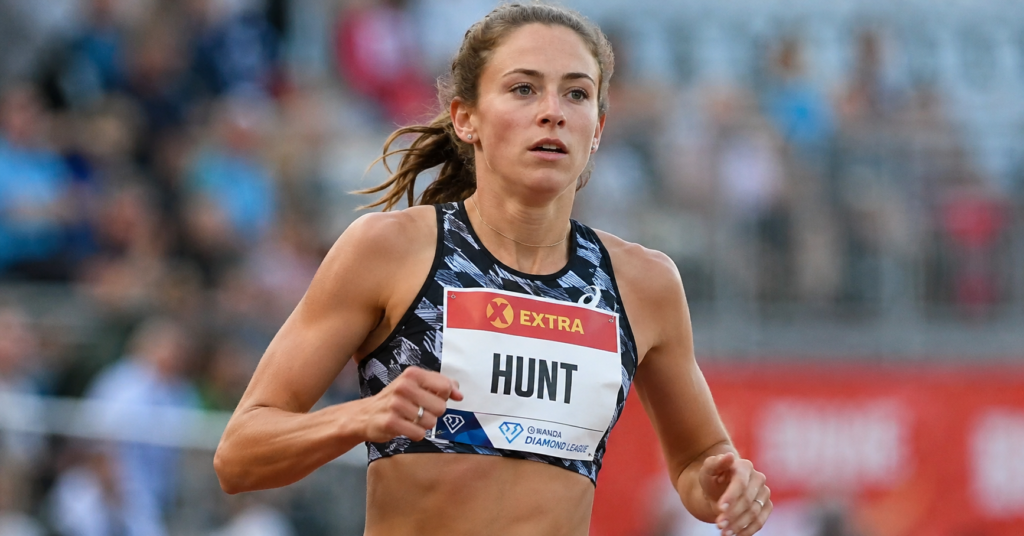

The name Amy Hunt sprinter has become increasingly familiar to athletics fans around the world. The British track star has built a reputation as one of the country’s most exciting sprint talents, combining remarkable speed with an unusual academic background. Born on May 15, 2002, in Grantham, Hunt has progressed from a record-breaking junior athlete to an Olympic silver medallist, world silver medallist and, most recently, European 100m champion.
Her journey has not been completely straightforward. Injuries, rehabilitation, the demands of elite competition and the challenge of balancing university studies have all shaped her career. Yet those experiences have helped create an athlete who appears increasingly comfortable on the biggest stages.
Who Is Amy Hunt?
Amy Hunt is a British sprinter who competes primarily in the 100 metres and 200 metres, while also representing Great Britain in the 4x100m relay. Her current profile places her among the leading British women in sprinting, with personal bests of 10.97 seconds for 100m and 22.08 seconds for 200m according to World Athletics.
Her breakthrough came remarkably early. In 2019, Hunt set a world under-18 record in the 200m, immediately attracting attention as one of the most promising young sprinters of her generation. That early success created considerable expectations, but she has gradually developed into a senior athlete rather than relying solely on her junior reputation.
Today, the story surrounding the Amy Hunt sprinter name is less about potential and more about achievement. Her medal record at major championships shows that she has successfully made the difficult transition from junior star to established international competitor.
A Record-Breaking Start
Hunt first gained major attention as a teenager. Her performances in the 200m demonstrated an impressive combination of speed, technique and finishing strength, culminating in the world under-18 record in 2019.
Such an achievement can sometimes create pressure for young athletes. Hunt, however, continued developing while also preparing for life beyond athletics. Her progression was affected by the disruption caused by the COVID-19 pandemic, while a tendon injury later required surgery and a lengthy rehabilitation process.
That period was an important part of her development. Sprinting is a sport in which tiny improvements in technique, strength, reaction and race execution can make a major difference. Returning from injury also requires patience, something that became an important part of Hunt’s story.
Cambridge and Elite Athletics
One of the most distinctive aspects of Hunt’s career is her academic background. She studied English at the University of Cambridge and graduated from Corpus Christi College in 2023 with an English degree.
Balancing university with international-level athletics is demanding. Elite sprinters typically have carefully structured schedules involving track sessions, strength training, recovery, travel and competition. Adding university assignments and examinations creates another layer of pressure.
Hunt has nevertheless embraced both sides of her identity. Her experience has also helped challenge the idea that elite athletes must choose between academic ambition and sporting success. She has spoken about encouraging young women to believe that they can pursue both goals.
The Move to Italy
Another major step in Hunt’s development came when she relocated to Italy. She has trained in Padua under coach Marco Airale, working within an international training environment designed around high-level sprint development. Athletics Weekly reported that Hunt had settled into the Italian training system and was benefiting from a combination of track work, gym training, recovery and rest.
The move represented more than a change of scenery. Elite athletes often make significant adjustments to their training environments when they reach a stage where small performance gains become increasingly important.
For Hunt, the Italian chapter has coincided with substantial progress. Her sprinting has become more consistent, and her times have continued to move in the right direction.
Olympic and European Success
Hunt became part of the British women’s 4x100m relay team that won European gold in 2024. Later that year, she helped Great Britain secure Olympic silver in the 4x100m relay at Paris 2024. World Athletics lists her as an Olympic silver medallist and European champion.
Relay success is particularly significant in British athletics because the 4x100m requires much more than four fast runners. Baton exchanges, positioning, communication and timing can determine the result.
Hunt’s development in the relay therefore provided valuable experience at major championships. It also gave her an opportunity to compete alongside established British sprint stars while continuing to build confidence at senior level.
A Breakthrough in the 200 Metres
The biggest individual breakthrough of Hunt’s career came at the 2025 World Athletics Championships in Tokyo. She won silver in the women’s 200m, earning her first individual medal at a major senior global championship.
Her personal best of 22.08 seconds was recorded in September 2025, underlining the level she had reached by that stage.
The result changed the perception of Hunt. Instead of being viewed mainly as a promising former junior record-holder, she had become a genuine championship medal contender.
Her personality also attracted considerable attention after that performance. Hunt’s comments following her world silver medal became widely discussed, adding a distinctive personal dimension to her growing public profile.
Amy Hunt Sprinter Makes History in 2026
The 2026 season has taken Hunt’s career to another level. Earlier in the year, she broke the 11-second barrier in the 100m, becoming only the fourth British woman to achieve that milestone, according to Team England.
World Athletics currently lists her 100m personal best as 10.97 seconds, achieved in June 2026. Her 2026 personal-best list also includes 7.04 seconds for 60m.
Those numbers demonstrate that Hunt is no longer viewed only as a 200m specialist. Her development over 100m has made her a more complete sprinting threat and strengthened her position within the British team.
European 100m Champion
On August 10, 2026, Hunt reached another major milestone by winning the women’s 100m title at the European Athletics Championships in Birmingham. She crossed the line in 11.00 seconds, finishing ahead of Poland’s Ewa Swoboda and Belgium’s Delphine Nkansa.
The victory was particularly meaningful because it came in front of a home British crowd. It was Hunt’s first major individual senior title and represented another important step in her transformation from emerging talent into an established championship athlete.
Her performance also highlighted one of her notable racing characteristics. While her starts have sometimes been less spectacular than those of her rivals, Hunt has shown an ability to finish strongly and produce significant speed through the latter stages of a race. Her European final demonstrated that quality again.
What Makes Hunt So Interesting?
The appeal of the Amy Hunt sprinter story goes beyond medals and times. Her career combines elite sport, education, resilience and personality.
She has experienced injury setbacks without allowing them to define her career. She completed a university degree while pursuing international athletics. She moved abroad to improve her training environment and has continued developing rather than becoming satisfied with early success.
There is also a clear sense of ambition. Hunt has spoken publicly about wanting to become an important figure in athletics and about the possibility of pushing herself toward even greater sprint performances.
That ambition is supported by evidence. Her progression from a teenage world-record holder to Olympic relay medallist, world individual silver medallist and European champion shows a sustained upward trajectory.
What Comes Next for Amy Hunt?
At 24, Hunt remains relatively young for an elite sprinter. Her best years may still be ahead of her, particularly as she continues refining the technical details of her 100m and 200m races.
The immediate focus is the remainder of the 2026 European Championships, where she is also targeting the 200m and relay events. Her recent 100m title gives her additional confidence, but championship sprinting remains unpredictable and every race presents a new challenge.
Longer term, Hunt has the opportunity to establish herself among Britain’s leading sprint personalities. Her combination of 100m speed, 200m experience and relay ability gives her several routes to major championship success.
Frequently Asked Questions About Amy Hunt
Who is Amy Hunt?
Amy Hunt is a British track-and-field sprinter specializing in the 100m and 200m. She is an Olympic silver medallist, world silver medallist and European champion.
How old is Amy Hunt?
Amy Hunt was born on May 15, 2002, making her 24 years old in August 2026.
What is Amy Hunt’s fastest 100m time?
Her current personal best is 10.97 seconds, recorded in June 2026.
What is Amy Hunt’s 200m personal best?
Hunt’s 200m personal best is 22.08 seconds, achieved in September 2025.
What major medal has Amy Hunt won?
Among her biggest achievements are Olympic silver in the 4x100m relay at Paris 2024, world silver in the individual 200m at the 2025 World Championships and European 100m gold in Birmingham in 2026.
Conclusion
The story of Amy Hunt sprinter is one of steady development, resilience and growing achievement. From setting a world under-18 record as a teenager to balancing Cambridge studies, overcoming injury and winning major senior medals, Hunt has taken a distinctive path through elite athletics.
Her European 100m victory in Birmingham marks a particularly important moment because it confirms that she can deliver when a major individual title is on the line. With strong performances already behind her and plenty of competitive years potentially ahead, Amy Hunt has established herself as one of Britain’s most intriguing sprint stars.
Her journey is still being written, but the evidence so far suggests that the former junior prodigy has successfully become something more valuable: a proven senior championship athlete with the ambition and ability to aim even higher.