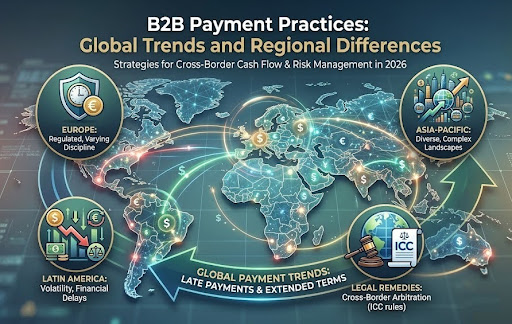

Global Payment Trends Since 2024
Since 2024, late payments have remained a defining feature of international B2B trade. Industry data shows that over 40% of invoices are settled after due dates, with average delays increasing in sectors exposed to supply chain volatility and financing constraints. Payment terms have gradually extended beyond traditional 30–60 day periods, often reaching 90 days or more in cross-border agreements. These shifts reflect a structural adjustment in how companies manage liquidity, transferring financial pressure across supply chains rather than eliminating it.
European Markets: Regulation with Uneven Enforcement
The European Union continues to promote stricter payment discipline through regulatory initiatives, yet enforcement remains inconsistent. Northern European countries maintain relatively strong compliance, while Southern and Eastern markets experience longer delays linked to court inefficiencies and administrative processes. Despite harmonized frameworks, creditors still face procedural variation when pursuing cross-border debt dispute resolution within the EU. As a result, contractual clarity and dispute resolution mechanisms remain essential even within integrated markets.
Asia-Pacific: Diverse Practices and Growing Complexity
Asia-Pacific presents one of the most diverse payment landscapes. Markets such as Japan and Singapore maintain relatively predictable payment cycles supported by strong legal infrastructure. In contrast, parts of Southeast Asia and South Asia experience longer delays influenced by local business practices, regulatory complexity, and slower dispute resolution systems. Exporters operating in this region must adapt to varying expectations around negotiation and escalation, often requiring localized collection strategies.
Latin America and Emerging Markets: Volatility and Structural Delays
In Latin America, payment practices are heavily influenced by currency fluctuations, inflation, and regulatory constraints. Delays often extend beyond contractual terms due to financial instability rather than intentional default. Similar patterns are observed in other emerging markets, where limited access to financing affects buyer liquidity. For creditors, these environments increase the importance of assessing counterparty risk before extending credit and preparing for longer recovery cycles.
Legal Considerations in Cross-Border Payment Recovery
As payment delays escalate into disputes, legal strategy becomes central. The arbitration vs litigation choice significantly impacts recovery timelines and outcomes. Litigation across jurisdictions often involves complex recognition procedures, while international arbitration debt claims provide a more consistent framework for resolving disputes. Arbitration mechanisms described in the ICC arbitration guide offer procedural clarity and global enforceability, making them particularly relevant for cross-border transactions.
Enforcing arbitration awards remains one of the most effective ways to secure payment internationally. ICC debt recovery procedures support structured dispute resolution, allowing creditors to move from claim initiation to enforcement across multiple jurisdictions with greater predictability.
Impact on Credit Management Strategies
The persistence of late payments is reshaping credit management practices globally. Companies are increasingly integrating legal foresight into commercial decision-making, including the use of arbitration clauses, enhanced due diligence, and continuous monitoring of receivables. Credit managers are shifting from reactive collection approaches to proactive risk management, focusing on early identification of payment issues and faster escalation when needed.
Strategic Direction for Global Businesses
Regional differences in payment behavior will continue to define international trade risk. Companies that adapt their credit policies, contractual structures, and recovery strategies to local conditions will be better positioned to maintain financial stability. Many businesses rely on experienced partners such as cisdrs.com to manage cross-border debt recovery and navigate complex international enforcement environments efficiently.