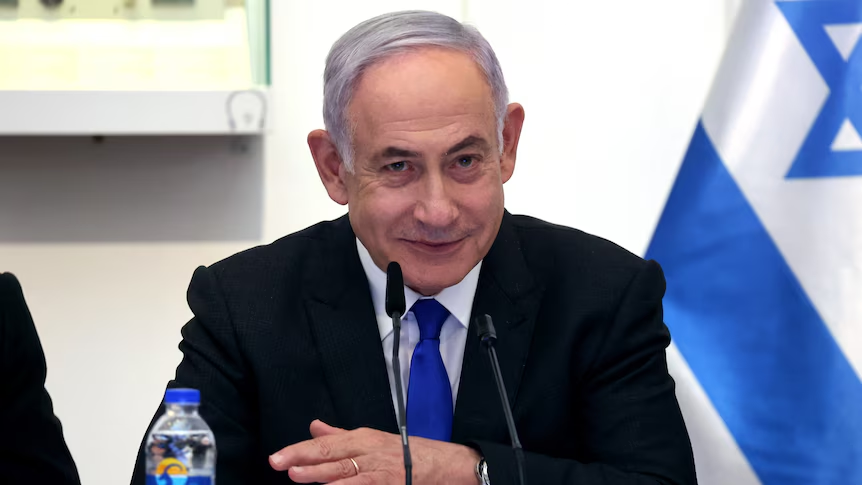

Is Benjamin Netanyahu dead? The question has repeatedly surged across social media during periods of conflict in the Middle East, creating confusion among people searching for reliable information. As of August 14, 2026, Benjamin Netanyahu is alive and remains Israel’s prime minister, with recent reporting showing him actively involved in political and diplomatic affairs. Current Reuters and Associated Press coverage continues to identify Netanyahu as Israel’s serving prime minister.
The latest wave of speculation is not supported by credible evidence of his death. Instead, it reflects how quickly rumors can spread during wartime, particularly when a prominent political leader has limited public appearances or when manipulated videos and images circulate online.
Is Benjamin Netanyahu Dead? Here Is What We Know
No. Benjamin Netanyahu is not dead, according to the latest credible information available as of August 14, 2026. Recent international news coverage continues to report on his decisions, public statements and political challenges.
Reuters reported on August 14 that the United States was pressing Netanyahu to publicly condemn an Israeli settler siege of Palestinian homes in the West Bank. The report discussed Netanyahu’s political position and his decision not to comment publicly on that particular incident.
That is important because it provides contemporary evidence that Netanyahu remains an active political figure. Separate reporting has also covered his rejection of a proposed Gaza peace plan backed by U.S. President Donald Trump.
Therefore, claims circulating online that Netanyahu has died should not be treated as established fact.
Why Did Rumors About His Death Spread?
Rumors about Netanyahu’s death became particularly widespread during the 2026 conflict involving Israel, the United States and Iran. Wartime conditions create an environment where information can become difficult to verify, especially when governments restrict details about the movements and security of senior officials.
In March 2026, Iranian state media and pro-Iranian accounts circulated claims that Netanyahu had been killed or injured. The reports gained attention online, with social media users sharing photographs, videos and alleged evidence without reliable confirmation. Reuters reported that Netanyahu responded by publishing a video showing himself visiting a café and getting coffee.
The incident demonstrated how quickly a rumor can become a global search trend. Once thousands of people begin asking whether a public figure has died, the question itself can make an unverified claim appear more credible than it actually is.
Fake Videos Added to the Confusion
Another reason the rumors gained traction was the growing use of artificial intelligence to create convincing-looking images and videos.
In March, social media users questioned a video of Netanyahu because they believed his hand appeared to have an unusual number of fingers. Some posts argued that the footage had been generated by artificial intelligence and suggested this was proof that the real Netanyahu was dead.
Fact-checking by PolitiFact found that the claim was false. A closer examination showed that Netanyahu’s hands were normal and that the apparent extra finger was caused by the way the image appeared. The video itself did not provide evidence that Netanyahu had died.
BBC reporting also examined the wider rumor and found that fake photographs and AI-generated material had been used to support the false claim that Netanyahu had been killed in an Iranian strike.
This episode illustrates an increasingly important challenge for anyone following breaking news: visual material is no longer automatically reliable simply because it looks realistic.
Netanyahu Has Publicly Responded to Death Rumors
One of the clearest moments in the rumor cycle came when Netanyahu himself responded indirectly to reports claiming he was dead.
In March, he appeared in a video filmed at a café near Jerusalem. The footage showed him drinking coffee and speaking with his aide. Reuters independently verified the location using images of the café and confirmed the timing through material posted by the establishment.
Rather than treating the rumors as a serious announcement, Netanyahu used humor while responding to the situation. His appearance quickly became evidence contradicting claims that he had been killed.
However, the episode also demonstrated why verification matters. A single social media post should never be considered enough evidence for a major claim involving the death of a national leader.
What Is Benjamin Netanyahu Doing Now?
As of August 14, 2026, Netanyahu remains deeply involved in Israeli politics and regional diplomacy.
One of the major issues surrounding him is the future of Gaza. Netanyahu recently rejected a 15-point peace proposal associated with President Trump. The proposal included Hamas disarmament and an Israeli military withdrawal, but Netanyahu has maintained that Israel should not withdraw until Hamas is fully disarmed.
The disagreement has created political and diplomatic pressure around the Israeli government. Netanyahu is also preparing for a difficult political environment ahead of Israel’s October election, adding another layer of uncertainty to his position.
Recent reporting from Reuters and other major news organizations therefore paints a picture of an active political leader facing serious challenges—not a deceased former prime minister.
Why Death Rumors Can Become So Powerful
The spread of false death reports is not unique to Netanyahu. Famous politicians, entertainers and other public figures have frequently been the subjects of premature death rumors.
For political leaders, however, the consequences can be considerably more serious. A false report about the death of a national leader can affect financial markets, diplomatic calculations, military decision-making and public confidence.
During an active conflict, uncertainty can make the situation even more dangerous. People may share unverified information because they believe they are helping others, while the opposite can happen: the sharing itself gives misinformation greater reach.
The Netanyahu rumors also show how algorithms can amplify emotionally charged claims. A dramatic headline asking whether a famous leader has died is more likely to attract attention than a cautious statement explaining that there is no evidence of such an event.
How to Check Claims About Netanyahu’s Death
When a claim as significant as is Benjamin Netanyahu dead begins trending, the best approach is to pause before accepting or sharing it.
Reliable confirmation would normally come from several established news organizations, official government statements or direct reporting from trusted journalists. A screenshot, anonymous social media account or AI-generated video should not be considered sufficient proof.
It is also useful to check the date of the information. Old rumors can suddenly become popular again when users repost archived material without explaining when it was originally published.
In Netanyahu’s case, the most recent reporting available on August 14, 2026 continues to discuss his decisions and political activities. That makes the current death rumor inconsistent with the established reporting record.
The Bigger Story Behind the Rumor
The recurring question is Benjamin Netanyahu dead is ultimately part of a broader story about misinformation in the digital age.
The internet has made it possible for breaking information to travel around the world within seconds. That speed can be useful when news is accurate, but it also allows false claims to spread before journalists have time to investigate them.
Artificial intelligence has made the situation more complicated because fabricated photographs, altered videos and synthetic audio can appear convincing to people who are not familiar with the signs of manipulation.
The Netanyahu case is a useful reminder that credibility matters more than virality. A claim receiving millions of views does not make it true.
Frequently Asked Questions
Is Benjamin Netanyahu dead in 2026?
No. As of August 14, 2026, credible reporting indicates that Benjamin Netanyahu is alive and continues serving as Israel’s prime minister. Reuters and other major news organizations have reported on his current political activities.
Where did the Netanyahu death rumors come from?
Major rumors circulated during the 2026 Israel-Iran conflict, including claims from Iranian state media and accounts on social media. The allegations were not supported by reliable evidence, and Netanyahu later appeared publicly in a video.
Were videos claiming Netanyahu was dead real?
Some material shared online was misleading or manipulated. Fact-checkers also examined claims that an apparent extra finger in a Netanyahu video proved it was AI-generated and found the allegation false.
Is Netanyahu still Israel’s prime minister?
Yes. Current reporting dated August 14, 2026 continues to identify Benjamin Netanyahu as Israel’s prime minister and discusses his government’s domestic and foreign-policy decisions.
Conclusion
So, is Benjamin Netanyahu dead? The answer is no based on the latest reliable information available on August 14, 2026. Netanyahu remains Israel’s prime minister and continues to participate in major political and diplomatic developments involving Gaza, the United States and the wider Middle East.
The repeated death rumors demonstrate why readers should be careful with sensational social media claims, particularly during wartime. False reports can spread quickly, while credible confirmation often takes longer.
For anyone searching is Benjamin Netanyahu dead, the most responsible answer is to rely on current reporting from established news organizations and official sources rather than viral posts, manipulated images or anonymous claims. At present, the evidence clearly indicates that Benjamin Netanyahu is alive and remains an active figure at the center of Israeli politics.