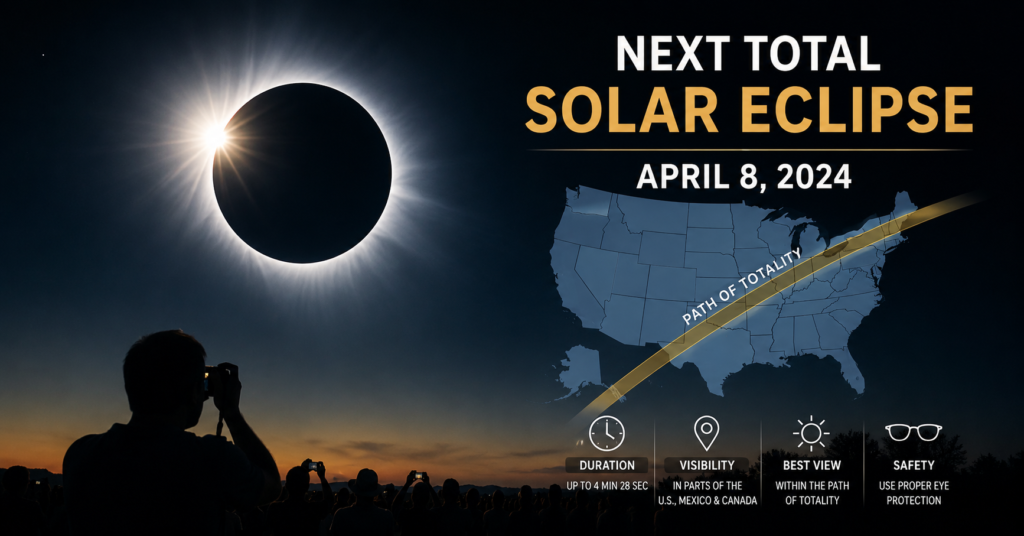

The next total solar eclipse is almost here, and skywatchers around the world are preparing for one of the most remarkable astronomical events of 2026. On August 12, 2026, the Moon will pass directly between Earth and the Sun, briefly blocking the Sun’s bright disk and creating darkness in the middle of daytime.
The event will be visible as a total solar eclipse from parts of Greenland, Iceland, Spain, northern Russia, and a small area of Portugal. A much wider region, including much of Europe, parts of North America, Africa, and surrounding oceans, will experience a partial eclipse.
When Is the Next Total Solar Eclipse?
The next total solar eclipse will occur on Wednesday, August 12, 2026. The timing and appearance will vary significantly depending on where an observer is located.
The Moon’s shadow will begin its journey across Earth in the far northern regions before moving through the Arctic and North Atlantic. The path of totality will then cross Iceland and Spain before the event moves toward the end of its visible path.
For people standing inside the narrow path of totality, the Moon will completely cover the Sun. Outside that path, viewers will see only a partial eclipse, meaning some portion of the Sun will remain visible.
Where Will the Eclipse Be Visible?
The total phase will be visible from a relatively narrow corridor. Greenland, Iceland, northern Russia, Spain, and a small part of Portugal are among the key locations where observers can experience totality.
Iceland is expected to be particularly interesting because the eclipse will occur during the late afternoon. In Reykjavík, for example, NASA lists totality beginning at approximately 5:48 p.m. local time and ending about a minute later.
In Spain, the timing will be much later. NASA’s published information shows totality beginning around 8:28 p.m. in León, while Valencia and Zaragoza will experience totality shortly after 8:30 p.m. local time. In several Spanish locations, the eclipse will occur close to sunset, creating a potentially dramatic combination of an eclipsed Sun and evening sky.
What Makes a Total Solar Eclipse Special?
A total solar eclipse is different from an ordinary partial eclipse because the Moon completely covers the bright surface of the Sun for observers located within the path of totality.
During totality, the sky can become dramatically darker, temperatures may change, and bright stars and planets can become easier to notice. Most importantly, the Sun’s outer atmosphere, known as the corona, becomes visible around the dark silhouette of the Moon.
The corona is normally hidden by the intense brightness of the Sun’s visible surface. Totality temporarily creates the contrast needed for observers and scientists to study this fascinating region of the solar atmosphere.
How Long Will Totality Last?
One of the most surprising facts about a total solar eclipse is how quickly the most dramatic moment passes.
For most locations along the path of totality in 2026, the Sun will be completely covered for less than two minutes. Near portions of the central path in Greenland, Russia, and the North Atlantic, totality will last somewhat longer, but NASA says it will still remain under two and a half minutes.
The short duration is part of what makes total eclipses so memorable. The Moon’s shadow travels rapidly across Earth, and even a small difference in location can change how long totality lasts.
Choosing a location close to the center of the path generally provides a longer period of totality than watching from the edge.
Why Does a Solar Eclipse Happen?
A solar eclipse occurs when the Sun, Moon, and Earth become aligned closely enough for the Moon to cast its shadow on Earth.
The Moon has two important parts to its shadow. The umbra is the central region where the Sun can be completely blocked, while the penumbra is the larger surrounding region where only part of the Sun is covered.
People standing within the umbra can experience totality. Those in the penumbra see a partial eclipse. NASA explains that the Moon’s shadow on Earth’s surface is only around 480 kilometers wide, which helps explain why total solar eclipses are visible from such limited areas.
What Will People See During Totality?
The visual transformation can happen surprisingly quickly.
As the Moon gradually moves across the Sun, daylight becomes noticeably dimmer. Shadows may appear unusual, and the surrounding environment can take on an unfamiliar appearance.
When the final portion of the Sun disappears, the sky can become dramatically darker. The Moon appears as a black disk surrounded by the delicate light of the solar corona.
This is also the only stage of a total solar eclipse when people can briefly look directly at the completely eclipsed Sun without solar viewing glasses. As soon as any part of the bright solar surface becomes visible again, proper eye protection is necessary.
How to Watch the Eclipse Safely
Watching a solar eclipse requires more care than simply looking toward the sky.
During the partial phases, observers should use proper solar-viewing glasses or a safe handheld solar viewer. Ordinary sunglasses do not provide adequate protection for directly viewing the Sun.
The important rule is simple: solar eye protection should remain in place throughout the partial phases. Only during the brief period of totality, when the Sun’s bright surface is completely hidden by the Moon, can viewers remove the protection.
People should also be cautious with cameras, binoculars, and telescopes. Looking at the Sun through optical equipment without an appropriate solar filter can cause serious eye damage.
Scientists Are Preparing Too
The next total solar eclipse is not just a spectacular event for tourists and amateur skywatchers. It also offers scientists a valuable opportunity to study the Sun and Earth’s atmosphere.
NASA-supported research teams plan to use aircraft and scientific balloons during the August 2026 eclipse. A high-altitude NASA WB-57 aircraft will observe the eclipse from above, while balloon projects in Iceland and Spain will investigate atmospheric changes associated with the sudden loss of sunlight.
Researchers are particularly interested in the solar corona and in how Earth’s atmosphere responds when daylight is temporarily interrupted. Such observations can provide information that is difficult or impossible to obtain under normal daytime conditions.
Is 2026 the Only Upcoming Total Eclipse?
Although the August 2026 event is the next total solar eclipse, it will not be the last one in the near future.
NASA’s future eclipse calendar shows an annular solar eclipse on February 6, 2027, followed by another total solar eclipse on August 2, 2027. The 2027 total eclipse will cross parts of southern Spain, North Africa, Saudi Arabia, and Yemen.
That makes the years ahead especially interesting for eclipse enthusiasts. The 2026 eclipse will be followed by another major total eclipse only about a year later, although the viewing locations will be very different.
Frequently Asked Questions
When is the next total solar eclipse?
The next total solar eclipse will take place on August 12, 2026. Totality will be visible along a narrow path crossing parts of Greenland, Iceland, northern Russia, Spain, and a small section of Portugal.
Will the eclipse be visible everywhere?
No. Totality is limited to a narrow path. However, a partial solar eclipse will be visible across a much larger area, including much of Europe, parts of North America and Africa, and surrounding ocean regions.
Can I look at the eclipse with normal sunglasses?
No. Normal sunglasses are not designed for direct solar viewing. During the partial phases, use certified solar viewing glasses or another safe solar-viewing method.
How long will totality last?
The duration depends on location. For most observers along the path, totality will last less than two minutes. Locations closer to the center of the eclipse path can experience a somewhat longer period, with the maximum remaining below two and a half minutes according to NASA.
When is the next total solar eclipse after 2026?
The next total solar eclipse after the August 2026 event will occur on August 2, 2027. Its path will include parts of southern Europe, North Africa, Saudi Arabia, and Yemen.
Final Thoughts
The next total solar eclipse on August 12, 2026, promises to be an extraordinary meeting of astronomy, science, and natural beauty. For a few fleeting minutes, the Moon will line up perfectly with the Sun and Earth, turning an ordinary day into an unforgettable celestial event.
For those lucky enough to stand inside the path of totality, the experience will be much more than simply watching the Sun disappear. The sudden darkness, visible corona, changing atmosphere, and remarkable precision of the alignment all demonstrate how dynamic our solar system really is.
Whether viewed from Iceland, Spain, Greenland, Russia, or another location experiencing a partial eclipse, August 12 will give millions of people an opportunity to look upward and witness one of nature’s most spectacular events.