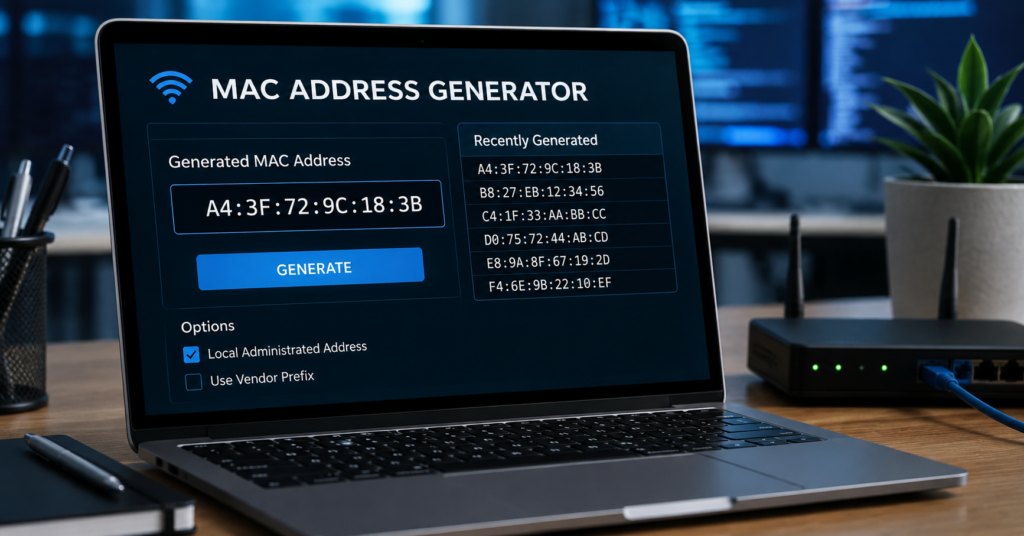

A mac address generator is a useful networking tool that helps users create valid Media Access Control (MAC) addresses for testing, software development, network simulations, privacy protection, and educational purposes. While many people have heard of IP addresses, MAC addresses play an equally important role in identifying devices within a local network. Whether you are an IT professional, a cybersecurity student, or simply curious about networking, understanding how a mac address generator works can help you use networks more effectively and responsibly.
Unlike random online utilities with unclear functionality, a quality MAC address generator creates properly formatted addresses that follow networking standards. This article explains what a MAC address is, how these generators work, where they are commonly used, and the best practices for using them ethically.
What Is a MAC Address?
A Media Access Control address, commonly known as a MAC address, is a unique identifier assigned to a network interface. Every device capable of connecting to a wired or wireless network, such as a laptop, smartphone, router, printer, or gaming console, has a MAC address associated with its network hardware.
A standard MAC address contains twelve hexadecimal characters grouped into six pairs. These characters identify the manufacturer and the specific network interface. Unlike an IP address, which may change depending on the network, a MAC address is primarily used for communication within a local network.
Although manufacturers assign permanent MAC addresses, many modern operating systems now support randomized or temporary MAC addresses to improve user privacy.
Understanding a MAC Address Generator
A mac address generator is software or an online utility designed to generate valid MAC addresses that follow the proper formatting rules. It does not create real hardware identities tied to existing devices. Instead, it produces addresses that are structurally correct and suitable for legitimate testing and development purposes.
Most generators allow users to create completely random MAC addresses or specify certain prefixes that represent particular hardware manufacturers. Some advanced tools also let users generate large batches of addresses for virtual machines, network simulations, and software testing environments.
The generated values are intended for legal and authorized activities rather than bypassing network security or impersonating another device.
How Does a MAC Address Generator Work?
Every MAC address follows a standardized format defined by networking standards. The first portion typically represents the manufacturer, while the remaining characters identify the specific device.
When using a generator, the software follows these formatting rules to ensure the output appears as a valid MAC address. Some generators include options to create locally administered addresses, which are commonly used in virtualization and testing environments.
Because the generator follows established formatting rules, the resulting addresses are technically valid, even though they are not permanently assigned by hardware manufacturers.
Common Uses of a MAC Address Generator
One of the most valuable uses of a MAC address generator is within software development. Developers often build networking applications that require multiple virtual devices. Instead of manually creating addresses, they can quickly generate valid ones for testing.
Network administrators also benefit from these tools when setting up virtual machines, laboratory environments, or simulated enterprise networks. This allows them to verify configurations without using actual production hardware.
Cybersecurity professionals frequently rely on generated MAC addresses during penetration testing and security assessments conducted with proper authorization. Controlled testing environments require realistic network identifiers without affecting real-world devices.
Educational institutions use MAC generators to teach networking concepts in classrooms and virtual laboratories. Students can safely learn about network communication without modifying actual hardware settings.
Privacy and Modern Networking
Privacy has become increasingly important in today’s connected world. Many smartphones, laptops, and tablets now use randomized MAC addresses when scanning for wireless networks. This helps reduce device tracking in public locations.
Although this feature is built directly into modern operating systems, understanding the role of a mac address generator helps users appreciate how randomized addressing contributes to privacy. It demonstrates that changing a MAC address can have legitimate uses beyond technical experimentation.
Users should remember that MAC randomization enhances privacy only within local networks and does not replace broader cybersecurity practices such as encryption or secure authentication.
Benefits of Using a MAC Address Generator
One major advantage is convenience. Instead of manually creating hexadecimal combinations, users receive correctly formatted addresses instantly.
Another benefit is accuracy. Reliable generators produce addresses that comply with accepted networking standards, reducing configuration errors during testing.
Flexibility is equally valuable. Many generators support vendor prefixes, locally administered addresses, multicast options, and bulk generation, making them suitable for different technical requirements.
Efficiency also improves significantly when deploying multiple virtual systems or laboratory environments. Automated generation saves time while reducing the likelihood of duplicate addresses within controlled networks.
Responsible and Ethical Usage
Like many networking tools, responsible usage is essential. A MAC address generator should only be used in environments where you have authorization to perform testing or development activities.
Attempting to impersonate another device on networks you do not own or administer may violate organizational policies, service agreements, or local laws. Ethical professionals use generated MAC addresses for education, research, troubleshooting, virtualization, and software development rather than unauthorized access.
Maintaining clear documentation and following your organization’s security policies helps ensure that generated addresses remain part of legitimate technical workflows.
Features to Look for in a Quality Generator
Not every generator offers the same functionality. Reliable tools typically include proper hexadecimal validation, customizable formatting, vendor selection, and support for locally administered addresses.
Some applications also provide export options, allowing users to save generated addresses for large-scale deployments. Others integrate with scripting environments to automate network simulations or virtual machine creation.
Ease of use is another important consideration. A clean interface with straightforward options reduces mistakes and helps both beginners and experienced professionals generate valid addresses efficiently.
Common Misconceptions
Many people believe changing a MAC address makes a device completely anonymous online. This is not true. MAC addresses operate primarily within local networks and are generally not transmitted across the wider internet.
Another misconception is that every generated MAC address belongs to a real device. In reality, generators simply create values that follow the correct format. They do not assign ownership or register the address with hardware manufacturers.
Some users also assume MAC address generators are inherently suspicious. In fact, they are widely used in professional IT environments for legitimate development, testing, education, and network management.
Choosing the Right MAC Address Generator
When selecting a generator, prioritize reliability, accurate formatting, and transparency. Well-designed utilities clearly explain how addresses are generated and avoid misleading claims.
Offline applications may be preferable for organizations with strict security requirements because they reduce reliance on internet connectivity. Developers may prefer command-line tools that integrate with automation scripts, while beginners often appreciate simple browser-based interfaces for educational purposes.
Regardless of the tool you choose, understanding networking fundamentals remains more valuable than relying solely on automation.
Conclusion
A mac address generator is an important networking utility that serves developers, IT administrators, cybersecurity professionals, educators, and students alike. By generating properly formatted MAC addresses, these tools simplify testing, virtualization, software development, and educational exercises without requiring physical hardware changes.
When used responsibly, a mac address generator supports efficient network management while promoting better understanding of how local network communication works. As networking technology continues to evolve alongside growing privacy concerns, knowing how MAC addresses function and when generated addresses are appropriate remains a valuable technical skill for anyone working with modern computer networks.
FAQ
What is a MAC address generator used for?
A MAC address generator creates properly formatted MAC addresses for software testing, virtualization, networking education, laboratory simulations, and authorized cybersecurity research.
Is it legal to use a MAC address generator?
Yes. Using a MAC address generator is generally legal when it is used for legitimate purposes such as development, testing, education, or network administration with proper authorization.
Can a generated MAC address replace a real hardware address?
Generated addresses can be assigned temporarily in supported operating systems or virtual environments, but they do not permanently replace the hardware-assigned MAC address stored by the network adapter manufacturer.
Does changing a MAC address hide my identity online?
No. Changing a MAC address mainly affects communication within a local network. It does not make internet activity anonymous or replace other privacy and security measures.
Who commonly uses MAC address generators?
Software developers, network engineers, cybersecurity professionals, system administrators, educators, students, and researchers commonly use MAC address generators for legitimate networking tasks and controlled testing environments.