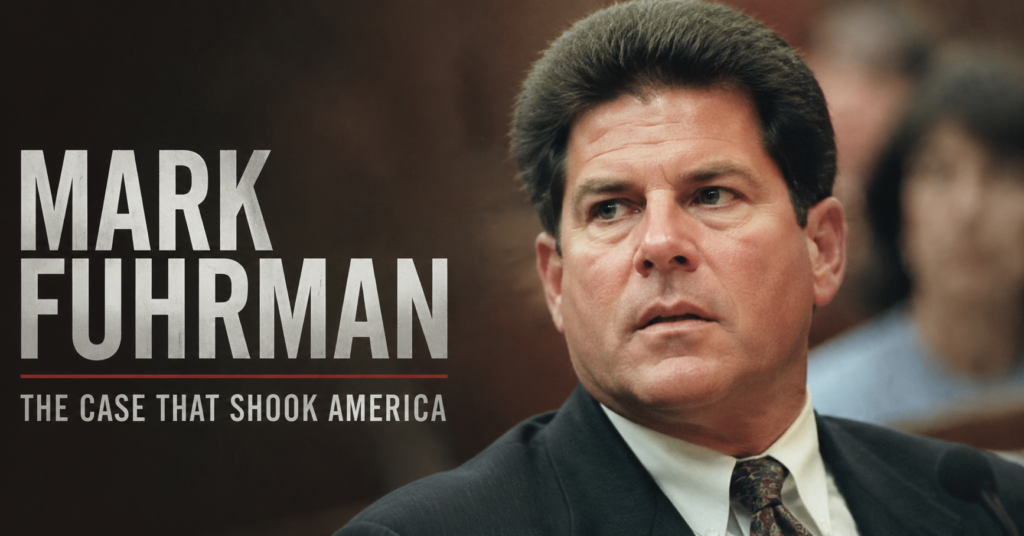

Mark Fuhrman’s name is instantly recognisable in American legal history — not for celebrity glamour or entertainment achievements, but for the seismic role he played in one of the most watched and debated criminal trials of the 20th century. As a Los Angeles Police Department detective at the centre of the O. J. Simpson murder case in 1994–1995, Fuhrman became the embodiment of a complex and polarising moment in the nation’s conversation about race, policing, and the search for truth in high-profile criminal investigations.
Born on February 5, 1952, in Eatonville, Washington, Fuhrman served in the U.S. Marine Corps before embarking on a career in law enforcement. After joining the LAPD in 1975, he steadily built a reputation as a dedicated if quiet officer, although later revelations about comments he made early in his career would cast a long shadow. His involvement in everyday policing eventually intersected with a case that would define his public legacy: the brutal murders of Nicole Brown Simpson and Ronald Goldman in Los Angeles in June 1994.
At the heart of the Simpson investigation, Mark Fuhrman was among the first detectives to respond to the crime scenes and was credited with discovering critical physical evidence, including a blood‑soaked glove near the scene that prosecutors argued connected Simpson to the murders. The glove became one of the defining symbols of the prosecution’s case and was featured dramatically during the trial.
Yet it was not merely the physical evidence that ensured Fuhrman’s central role in the trial — it was his testimony, and the questions surrounding his credibility, that would influence the course of the proceedings and reverberate far beyond the courtroom.
The Trial That Defined a Career
When the O. J. Simpson trial began in 1995, it captivated the American public in an extraordinary way. With a prominent former football star accused of killing his ex‑wife and her friend, every detail was magnified by the media and scrutinised by a nation straining to understand how justice should be served.
As one of the key detectives, Mark Fuhrman testified about the evidence he had found, including the infamous glove. But during cross‑examination, the defence sought to unravel his testimony by attacking his character — not just based on what he had done during the investigation, but on what he had said off the stand.
Prior to his testimony, Fuhrman was asked whether he had used racist language over the previous decade. He answered in the negative. However, the defence introduced recorded interviews made earlier in the 1990s in which he repeatedly used racial slurs. These tapes contradicted his testimony and called into question his honesty under oath.
The impact was profound. The defence team argued that if Fuhrman had lied about his language, then the jurors had reason to doubt every aspect of the prosecution’s case, including the integrity of the physical evidence. Even though there was no direct proof that he had planted evidence, the suggestion of bias and dishonesty became a cornerstone of the defence’s narrative. In the end, O. J. Simpson was acquitted in the criminal trial — a verdict that left the nation deeply divided.
Backlash, Consequences, and Later Life
Following the trial, the controversy around Mark Fuhrman did not fade. In 1996, he pleaded no contest to a charge of perjury for falsely denying in court that he had used racist epithets. He was sentenced to probation and fined, marking the only criminal conviction directly tied to the Simpson case.
Despite the tumult, Fuhrman did not vanish from public life. After retiring from the LAPD in 1995, he embarked on new roles as an author and media commentator. He penned books about true crime, including his perspective on the Simpson case, and made frequent appearances in radio and television discussions about law enforcement and criminal justice.
But even as he sought to reshape his story, the stain of the trial lingered. Discussions about Fuhrman often became shorthand for broader debates about racial bias, police culture, and the integrity of criminal investigations in America. For many, he came to represent the challenges that arise when personal conduct intersects with public trust in the criminal justice system.
Legacy and Final Chapter
In May 2026, Mark Fuhrman passed away at the age of 74 after an aggressive battle with throat cancer. His death was confirmed in Idaho, where he had spent his later years on a farm with his family. For observers and commentators, his passing closed a chapter on one of the most contentious figures in modern legal history.
The reactions to his death underscored the complexity of his legacy. Some relatives of the victims expressed sympathy and acknowledged positive aspects of his life beyond the trial, while others reiterated the profound impact that the Simpson case and its controversies had on the families involved.
Mark Fuhrman’s life and career do not easily fit into a single narrative. He was a law enforcement officer whose work helped bring attention to a vicious double murder. Yet he was also a man whose credibility, once challenged in court, became a focal point that shaped public perception of an entire trial. The repercussions of that trial extended far beyond the Simpson case itself, influencing subsequent conversations about race, justice, and how evidence is presented and perceived in the pursuit of truth.
Remembering a Complex Figure
Looking back, the story of Mark Fuhrman serves as a reminder of the human dimension behind headline‑grabbing legal battles. His experiences — from patrol officer to courtroom witness, from public controversy to later career as an author and commentator — reflect the tangled intersection of law enforcement, media, and public trust.
To some, he was a flawed figure whose actions undermined confidence in the criminal justice process. To others, he was simply a man entangled in one of the most extraordinary trials in American history. Regardless of perspective, his name remains forever linked to a defining moment in the nation’s legal memory — a testament to the lasting impact that a single individual can have on the way a society confronts its most difficult questions.
Frequently Asked Questions
Who was Mark Fuhrman and why is he significant?
Mark Fuhrman was a former Los Angeles Police Department detective best known for his role in the O. J. Simpson murder trial, where he discovered key evidence and later faced intense scrutiny over his credibility as a witness.
What was the controversy surrounding his testimony?
His credibility was damaged when previously recorded interviews surfaced showing him using racist language, which contradicted his sworn testimony and became a pivotal point in the defence strategy at Simpson’s trial.
Did Mark Fuhrman face legal consequences?
Yes. He pleaded no contest to a charge of perjury in 1996 for falsely denying the use of racist epithets in court, a conviction that marked the only criminal charge related to the trial.
What did he do after retiring from the LAPD?
After leaving law enforcement, Fuhrman wrote books on true crime and worked as a media commentator and radio host.
When did Mark Fuhrman die?
He died in May 2026 at the age of 74 after battling throat cancer, closing the life of a figure both criticised and studied in the annals of American legal history.