
The social security benefits bill has become an important topic for Americans watching retirement income, disability payments, survivor benefits, and the long-term stability of Social Security. The phrase can refer to different pieces of legislation rather than one single permanent law, so it is important to separate proposals from measures that have actually been enacted.
Social Security policy is constantly evolving as lawmakers consider ways to protect beneficiaries, improve the program’s finances, and respond to changing economic conditions. Recent legislation has already made meaningful changes, while additional proposals continue to attract attention in Congress. Understanding what has passed, what is being considered, and what remains unchanged can help beneficiaries avoid confusion.
Why Social Security Bills Matter
Social Security is more than a retirement program. It also provides benefits to eligible people with disabilities, surviving family members, and certain dependents. Because millions of households rely on these payments, even a relatively small legislative change can have a significant effect on monthly budgets.
Congress periodically considers legislation that could increase benefits, change eligibility rules, modify taxation, strengthen program administration, or address the financial condition of the Social Security trust funds. However, a bill introduced in Congress is not automatically a new benefit or requirement.
A proposal must move through the legislative process and ultimately become law before it can change federal benefit rules. This distinction is especially important when headlines or social media posts describe a proposed social security benefits bill as though it has already taken effect.
A Major Recent Change: Social Security Fairness Act
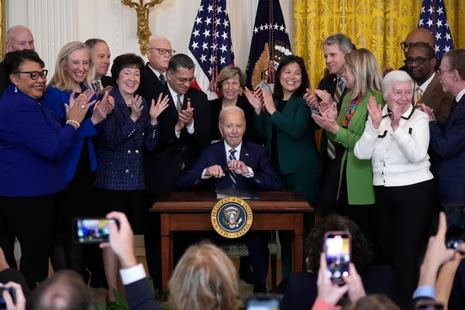
One of the most significant recent developments was the Social Security Fairness Act. President Joe Biden signed H.R. 82 into law on January 5, 2025.
The law repealed the Windfall Elimination Provision, commonly known as WEP, and the Government Pension Offset, or GPO. These provisions had affected certain people who received pensions from work that was not covered by Social Security.
According to the Social Security Administration, the new law applies to benefits payable for months after December 2023. WEP and GPO continue to apply to benefits payable for months before January 2024.
This change was particularly important for some public-sector workers and their families. Teachers, firefighters, police officers, and other government employees in positions that did not participate in Social Security could previously see their Social Security benefits reduced under these provisions.
The repeal does not mean every public employee automatically receives a larger Social Security payment. Eligibility and individual earnings histories still matter. The effect depends on a person’s circumstances and whether WEP or GPO previously applied.
What Beneficiaries Should Understand
When people search for a social security benefits bill, they are often trying to answer a simple question: “Will my monthly payment change?”
The answer depends on the specific legislation being discussed.
Social Security retirement benefits are generally calculated using a worker’s earnings history and the age at which benefits are claimed. Disability and survivor benefits have their own eligibility requirements. A new law may affect one category without changing every other Social Security benefit.
That is why broad claims about “everyone getting a new Social Security payment” should be treated carefully. Official announcements from the Social Security Administration and enacted legislation provide a much more reliable picture than viral posts or headlines.
The Bigger Financial Challenge
The debate surrounding Social Security is not only about today’s payments. Lawmakers are also confronting the program’s long-term financial outlook.
The Social Security Administration’s Office of the Chief Actuary publishes estimates of legislative proposals that could affect program finances. Its 2026 materials include proposals involving Social Security solvency, benefit changes, and Supplemental Security Income.
The central challenge is straightforward: Social Security must continue paying benefits while managing the relationship between incoming payroll tax revenue and outgoing benefits.
As the American population ages, policymakers face difficult decisions. Possible approaches discussed over the years include changing payroll taxes, modifying benefits, adjusting the retirement age, changing the way benefits are calculated, or using combinations of several policies.
There is no single universally accepted solution. Different proposals distribute costs and benefits differently among workers, retirees, employers, and taxpayers.
What a New Bill Could Change
A future social security benefits bill could address several areas of the program, depending on its language.
Some legislation focuses on increasing benefits for particular groups. Other proposals concentrate on improving administrative operations, preventing fraud, protecting beneficiaries from identity theft, or changing the rules governing Supplemental Security Income.
For example, the Social Security Administration maintains an extensive record of legislative proposals affecting Social Security and SSI. These proposals demonstrate that Social Security legislation can involve everything from benefit formulas and eligibility rules to administrative procedures and program financing.
That is why readers should always look beyond the title of a bill. The actual text determines who qualifies, when a provision begins, whether it is permanent or temporary, and how it interacts with existing Social Security law.
Social Security in 2026
Social Security remains a major source of financial support for retirees, people with disabilities, and survivors. The administration’s 2026 statistical materials provide detailed information about beneficiaries and current-payment status across the program.
Supplemental Security Income is separate from Social Security retirement insurance, although both programs are administered by the Social Security Administration. SSI is designed for people with limited income and resources who are aged, blind, or disabled.
For 2026, the federal SSI benefit rate is $994 per month for an eligible individual and $1,491 for an eligible couple. Other rules, including income exclusions and living arrangements, can affect the amount an individual actually receives.
Understanding the difference between Social Security and SSI is essential because legislation affecting one program does not necessarily change the other.
How Beneficiaries Can Avoid Confusion
Social Security legislation can be complicated, but beneficiaries can protect themselves from misinformation by focusing on a few basic questions.
First, determine whether a proposal has actually become law. Second, check whether the change applies to your specific type of benefit. Third, look at the effective date because some laws apply retroactively while others begin in a future year.
It is also important to avoid assuming that a bill’s introduction guarantees passage. Congress considers many proposals that never become law.
The Social Security Administration’s official legislative records show numerous bills and proposals across different Congresses, illustrating how frequently Social Security policy is debated and revised.
What Retirees Should Watch Next
Future Social Security legislation is likely to remain a major policy issue. Lawmakers face pressure from beneficiaries who want reliable payments today and from policymakers concerned about the program’s long-term financial sustainability.
The most important developments to watch are changes to benefit formulas, payroll taxation, eligibility rules, retirement policy, disability programs, SSI, and trust-fund financing.
For individuals already receiving benefits, the most useful approach is to pay attention to enacted laws rather than rumors about proposed legislation. A bill can attract considerable public attention without ever changing a beneficiary’s payment.
For workers planning retirement, the broader lesson is equally important: Social Security can be a valuable source of income, but retirement planning should account for personal savings, pensions where available, and other sources of income as well.
Frequently Asked Questions
What is the social security benefits bill?
The term social security benefits bill does not identify one single piece of legislation. It can be used to describe different congressional proposals involving Social Security retirement, disability, survivor, or related benefits. The specific bill number and legislative language are necessary to determine what a proposal would actually change.
Did the Social Security Fairness Act become law?
Yes. The Social Security Administration reports that President Biden signed H.R. 82, the Social Security Fairness Act of 2023, into law on January 5, 2025. It repealed WEP and GPO for benefits payable after December 2023.
Does every new Social Security bill increase monthly payments?
No. Some bills concern benefit increases, while others address financing, eligibility, administration, fraud prevention, or other aspects of the program. A proposal must become law before it can establish a new federal requirement or benefit.
Can Social Security rules change in the future?
Yes. Congress has authority to amend federal Social Security law. The program has been modified many times since the Social Security Act was established, and lawmakers continue to consider additional changes.
Where can people find reliable information about Social Security legislation?
The Social Security Administration publishes legislative information, actuarial estimates, program statistics, and other official materials. Beneficiaries should also distinguish carefully between introduced proposals and enacted laws.
Conclusion
The social security benefits bill debate reflects a much larger national conversation about retirement security, disability protection, survivor benefits, and the financial future of Social Security. Recent legislation, particularly the Social Security Fairness Act, has already changed important rules for certain beneficiaries, while additional proposals continue to receive attention.
For retirees and workers alike, the safest approach is to focus on legislation that has actually been enacted and to understand exactly which groups a law affects. Social Security policy can change over time, but informed decisions begin with accurate information rather than speculation.
As lawmakers continue debating the program’s future, beneficiaries will be watching closely. The ultimate goal of any successful reform will be to balance dependable benefits for current recipients with a financially sustainable Social Security system for future generations.